• Published on

    Cameras in Cuba

    I know it's hard to generate interest in stories of other people's holidays, but we did have a couple of weeks in Cuba in January so I can make a small photo-historical report. One piece of good news was that quite separately I saw two tourists (not Cubans) actually taking photographs with film cameras – in both cases as it happens the Canon AE-1. Obviously a sound piece of equipment, still going strong. Secondly, we did come across a flea market in one of the central squares of Havana on Saturday. A lot of the stalls had cameras; some Fed and Zorki, plenty of Lomo and Lubitel, a few low-end pre-war folding Kodaks, and one very tired-looking Bantam Special. This rather parallels the nature of the car population. Cuba is well-known for keeping 1950s American cars going (which is still true) and also has plenty of very tatty Skodas and Ladas, just like the cameras from the era when Cuba and the Soviet Union were close.
  • Published on

    A Gandolfi Prison Camera - in Prison

    ​On holiday in Anglesey earlier this year, we visited the charming town of Beaumaris. There's much to see including a splendid castle, the courthouse, and superb views across the Menai strait to the beauties of the North Wales scenery.
    You can also visit the old gaol; and most interesting it turned out to be. On the walk round the gaol various cells and other rooms have been set up to illustrate life in the prison for inmates, staff, visitors and so on. From the history of Gandolfi's we know that in the 1920s they got a contract from the Home Office to produce cameras, which continued until after World War Two. For now, a quotation from a document by Fred Gandolfi should suffice:

    In 1923 came a Contract to supply the Straits Settlements (Malay) with cameras for Police Prison Records. The order was for 12 cameras to take two pictures on a quarter plate each, with nine double book form plate-holders. This type of work led to supplying police cameras for use in the Irish Rebellion in 1925. In this case however the cameras were fitted with Thornton Pickard "Silent" roller blind shutters, since in many cases the camera was used through a hole in the wall to record the person unawares. Later came orders to supply the English, Scottish and Welsh prisons. Here the camera was larger to take three images on postcard (5.5 x 3.5 inches) fulllength, full face and profile. The difficulty with recording three images of different sizes was that the masking device had to be accurate without showing any margins in the divisions. In 1975 the Home Office ceased using wood cameras, having tried out all-metal roll-film apparatus. However some County Police continued to order our cameras but reverted to the original two-on quarterplate.

    These Gandolfi cameras have of course all been phased out in working prisons today. From time to time examples show up on the used market, usually with labels stuck on to the sliding mask of the plateholder to remind the user what order to take the pictures in – always a fullface view, and either one or both profiles, all on one plate. What I have never seen before, though, is what confronted me when I entered a room in Beaumaris Gaol for the reception of prisoners. There in a corner was a Gandolfi prison camera, in a well used state, but more or less ready to go. The camera is mounted on a stout black Gandolfi-made wooden tripod, itself screwed to the floor. Opposite the camera is a wooden turntable, to which is (again permanently) fixed a wooden upright chair. Obviously the prisoner was sat on the chair, which fixed him or her in the right position and at the right distance. An assistant could then simply rotate the turntable carrying the prisoner so that the three (in this case) views could be taken. Whether this was a standard procedure I do not know. The chair and turntable could easily have been made locally for an enterprising prison photographer, or the whole setup may have been supplied by central authorities.
  • Published on

    Wet Collodion and Digital Photography

    ​The wet collodion process seems to be undergoing a remarkable revival.  Modern materials can help a little – as well as the traditional glass and "tin" substrates, a lot of people are using black anodised aluminium to make positives. It's light, inexpensive, and comes with a protective film which can be peeled off just before use to ensure really clean starting position.
    I was set off down this track by a chance encounter with a Bristol-based photographer working with wet plates on a beach. Ed Low, an art student, had come across the process and was determined to make something of it himself. Despite having little practical support from his tutors, he has been able to make remarkable progress as I discovered when I interviewed him on the beach in the middle of winter. 
    As if that were not enough serendipity, there is more to come. In June I was on holiday in Iceland, and went into the city museum in Akureyri just to see what there was. The first room I went into turned out to be a temporary exhibition mounted by the museum's curator of photography Hörður Geirsson. The walls were covered with very well made 10 x 8 ambrotypes he had taken this year in the city, together with the cameras and the portable darkroom which Hörður had made to do the work. He had taught himself the process, including attendance at a workshop in the USA, and made himself all the equipment needed. That includes a 24 x 24" camera for which he made everything including the bellows, which has a very nice original Voigtländer Euryscope No.7 brass lens. Like Ed Low, he has also converted the boot of his car to form a travelling darkroom. Hörður plans to re-take as many as possible of their 19th century photographs from the same spot, and using the same technology.
    Whilst camera collectors are beginning to talk seriously about collecting digital equipment, practising digital photographers (at least some of them) are turning to the Victorian period's most successful photographic technology and reviving it for pictorial purposes. It's a strange world!
  • Published on

    More Online

    The archive of the Dallmeyer company in the 19th century has been made available online. Seán MacKenna photographed and digitised the production records of the Dallmeyer Lens Company, which are held by the Brent Archive, over a period of several years with the view to making these records available to all. This was still a work in progress at the time of his death in October 2012 and with the help of several people a website at www.thedallmeyerarchive.com has been published based on the records that he left. It enables the dating and identification of Dallmeyer lenses produced between 1863 and 1901, serial numbers 4500 to 65000 (approximately). There are sections on the more common lens types  produced between 1860 and 1900. Also included are biographies of John H Dallmeyer and Thomas R Dallmeyer, some information on Dallmeyer's workers and ten lantern slides showing them at work. There’s also a series of Dallmeyer catalogues, and price lists and adverts derived from the BJA, 1861 to 1900.
    The BJP has announced that its entire archive is to be digitised and made available to researchers worldwide, starting in 2014. It’s not clear what the timescale is for completion, nor what the charges for access might be. It promises to be an excellent tool for researchers into photographic history, especially if it comes with a good search facility.
    The Royal Photographic Society has digitised the entire run of the RPS Journal, from March 1853 to the end of 2012, at archive.rps.org. It is searchable, and free to access. The magazines can be browsed, or you can enter a search term and get a list of matches. Clicking one of these leads to a well-scanned two-page spread of the original magazine, where you can read the original article, including illustrations. Regrettably the search process is very basic – you can search for a specific word or phrase, but there’s no means of finding an article containing two separated words. And you have to be accurate – I got 159 references to Mr. Sutton but none at all to Mr Sutton. Nevertheless this will be a valuable resource for anyone researching photographers or cameras.
    Running at least until the end of April 2015, www.daguerreobase.org is a European funded non-profit research project that aims to collect at least 25,000 descriptions of daguerreotype objects in the Daguerreobase database and make a digital representation of them available. It is intended to document as many daguerreotypes as possible in public and private collections (yes, even if you only have one) and make images of them and many curatorial details available to all, also free of charge. The detail asked if you wish to enter an image is considerable, so some may be put off by the complexity. If you are looking for a photographer, location, or subject, or looking for daguerreotypes with particular characteristics, this is, or will be, the place to go.
    Henry Fox Talbot’s correspondence is now online at foxtalbot.dmu.ac.uk. De Montfort University has prepared a comprehensive edition of nearly 10,000 letters to and from Talbot, with a sophisticated search tool allowing you to home in on topics, correspondents, dates and so on. You get a transcription rather than a facsimile, with useful annotations from the researchers.
    The Lomo company – famed for “lomography”, and also the Kiev Arsenal factory, recently raised about $1.5m using the internet as a funding source, to design and build a new Petzval lens suitable for modern DSLRs – Canon or Nikon fitting. This seems remarkable in several ways – to raise such a large sum from the general public in 30 days, and that enough people would want the product. To quote from Lomography“Characteristic photos shot with the Petzval lens are recognizable for their sharpness and crispness in the centre, strong color saturation, wonderful swirly bokeh effect, artful vignettes and narrow depth of field. Because of the characteristic swirly bokeh effect that it produces, the New Petzval Lens is perfect for portraits where you want your subject to be the center of attention. The New Petzval Lens features premium glass optics and is manufactured in Russia by Zenit, a company with a long and distinguished history in lens design.” Historic Petzval lenses in your collection are probably inconveniently long in focal length for such small cameras, so if you want to try the experience this could be the way to go. You’ll need to stump up $459 for your pre-order, delivery later this year. It’s in a brass mount, and certainly looks the part. Alternatively, making one yourself from bits in the optical scrap box doesn’t look beyond the bounds of possibility.
  • Published on

    The biggest one I've ever seen

    Image description
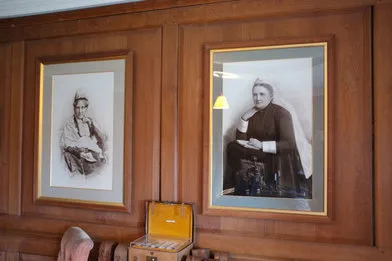
    Recently I paid a visit with the family to Castle Drogo, a National Trust property west of Exeter. I'd been before, but not for many years, so perhaps they've changed the displays. It is probably the last castle to be built in England, being completed in the 1920s as a family home for Julius Drewe, a grocer (Home & Colonial Stores) with mediaevalist interests. In Mrs Frances Drewe's boudoir are displayed the two largest Opalotypes I have ever seen!
    Opalotypes, or Opal Prints, were first seen in the mid-1860s but were of minor importance then. They became very popular as an up-market presentation around 1890-1900, and most collectors will have come across a few examples. A sheet of white (opal) glass carries a print - usually a carbon print made using Autotype carbon tissue, sometimes a collodion or silver/gelatin print made by coating the opal glass and processing in the usual way. It is an attractive format, with a good range of tones, and in its carbon form very durable, as neither the pigment nor the support suffer from the fading effects of light and the usual deteriorations of silver-based emulsions. They are naturally black and white, of course, but often hand- coloured either selectively or fully.
    They are commonly seen as portraits, like most other print processes sold to the general public. Examples I have previously come across are suitable for display in ordinary living rooms - that is to say, around whole-plate or 10x8 inches. I have in my collection several of those, and a 12x15 inch oval, which I thought was a big one. Audrey Linkman in her book on Victorian Portraits suggests 11x13 inches as a common size, and they are also known as portrait miniatures, following the lead of miniature paintings on ivory
    If you are building a castle, though, you don't do things by halves. As the illustration shows, two of these prints are enough to fill a wall. The portraits are of Julius's mother and Frances' mother, and are 33x45 inches plus frames. They are in excellent condition - there was no visible silvering, so I think they are probably carbon prints. The studio signature is Sauvy, Manchester, a photographer I haven't previously come across. He was of French origin - Adam Alphonse Sauvy was at the Maison Francaise in King St., Manchester from 1887-1900. The Castle Drogo prints must have been made by contact printing from enlarged copy negatives - possibly not by Sauvy, but were they printed by Lafosse, also of Manchester, and a large-scale Opalotype printer to the trade? The Collections Manager at Castle Drogo doesn't know, but a review of their photograph collection is planned for this winter, so we may find out more.
  • Published on

    False Colour

    Let me introduce the strange circumstances of the very first additive colour photograph, which worked even though it should not have.
    In 1802 Thomas Young proposed the theory of colour sensation in humans, suggesting that we have three sets of sensors, detecting red, green and blue. All colour sensations are either single primaries or mixtures in some proportion. This theory was further developed around 1850 by Hermann von Helmholtz, was confirmed physiologically, and is now understood in terms of the three types of cone cells in the retina.
    In 1855 the then-young Scottish physicist James Clerk Maxwell proposed, and in 1861 demonstrated, the first photograph taken using this principle. Additive colour displays, still used today in TV screens, combine R,G & B light sources to give full-colour images. (Most photographic colour systems in modern times have worked the other way - in subtractive colour, a multi-layered film removes unwanted colour from white light, either in transmission with slides, or reflection with paper prints.)
    Maxwell’s reasoning was that if photographs be taken of a coloured subject sequentially through red, green and blue filters, three monochrome images would result which would record the content of the three primary colours in the subject. If these are then processed to positives they can be projected through the original filters; by using three lanterns and carefully registering the images, the image of the subject should be displayed in its original colours.
    The trouble with Maxwell’s experiment was that although it appeared to work, it shouldn’t have. He was using the wet collodion process, which was only sensitive to UV and blue light. He should only have been able to record the blue channel. Maxwell found that his blue exposure was a few seconds, red 8 minutes, and for green he got nothing at all unless he made his filter rather weak and gave a very long exposure. Nevertheless, his result did not look too bad, as we can still see; his colour separations are preserved at the Cavendish Laboratory in Cambridge.
    The 1961 centenary of the event was celebrated by Ralph Evans of Kodak, who used the occasion to find out what happened. The sensitivity of the emulsion shows that half of the blue light would be recorded, as would a very small fraction of the green, and no red. However, the dye used to make the red in the ribbon reflects mostly in the red as you would expect, but has a significant secondary peak in the blue/UV region. This secondary peak, present in proportion to the amount of red in the scene, exposes the UV-sensitive wet collodion plate where red is visible to the eye. We now have an explanation for Maxwell’s exposure times as well. The blue was recorded normally, taking only twice the usual exposure for his plate; green was very difficult, relying on a tiny fraction of all the green present; and the red sensitivity was low but usable, as (we now know) there was a significant blue/UV content in proportion to the red.
    Maxwell’s method seemed to work because of his choice of subject, but could not then be used in the real world. His 1861 demonstration at the Royal Institution was the first time a colour photograph had been projected, but three-colour photography only became feasible once Vogel developed dyes (in 1873-84) to sensitise emulsions to a wider range of wavelengths. Maxwell’s principles eventually formed the basis of the early successful colour processes a generation after his demonstration, including Autochrome and three-colour cameras such as those of Ives and Miethe.